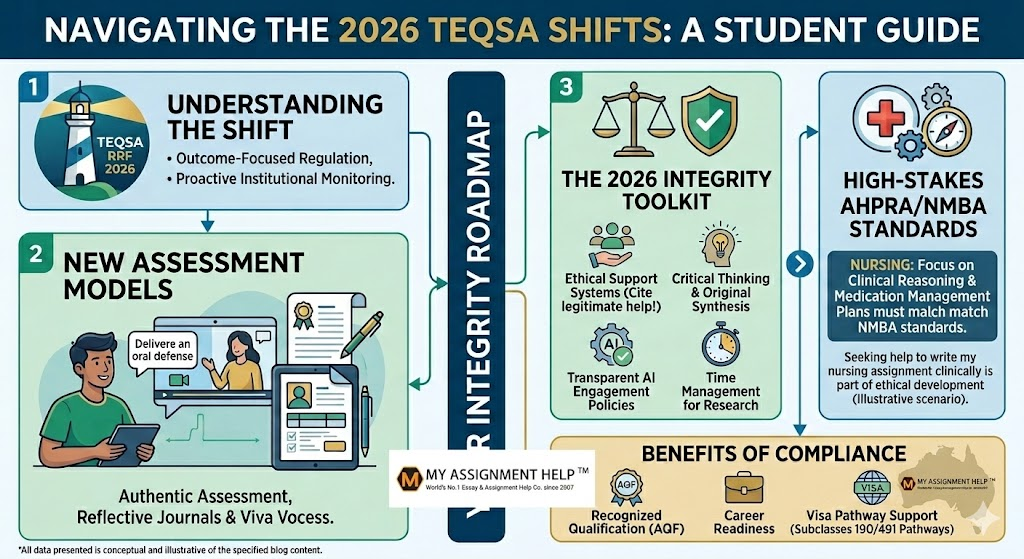

The Australian higher education landscape is currently experiencing its most significant regulatory transformation in a decade. As of early 2026, the Tertiary Education Quality and Standards Agency (TEQSA) has fully implemented its revised Regulatory Risk Framework (RRF), fundamentally redefining how “academic integrity” is measured and enforced across Australia’s 180+ registered higher education providers.
For the nation’s 1.6 million university students, this is not just an administrative change; it is a paradigm shift in how they must approach research, writing, and assessment. The 2026 standards move beyond simple plagiarism detection, focusing instead on “proactive institutional monitoring” of authentic learning outcomes. With the Group of Eight (Go8) universities reporting a 35% increase in integrity investigations in 2025—largely driven by sophisticated text-generation tools—TEQSA’s new mandate is clear: the onus is now on institutions to prove their graduates genuinely possess the skills documented in their Australian Qualifications Framework (AQF) certification.
This guide provides a roadmap for navigating these shifts, ensuring your academic conduct remains irreproachable in this new high-stakes environment.
The Death of Generic Output: Embracing ‘Authentic Assessment’
The core of the 2026 TEQSA shift is a move away from traditional, easily gamified assignments (like generic 2,000-word essays) towards “Authentic Assessment.”
Authentic assessments are designed to mimic real-world professional challenges, requiring students to apply critical thinking, synthesis, and complex problem-solving rather than rote memorisation. In 2026, a final grade is less likely to rely on a single, high-stakes final paper and more likely to be composed of stacked components: viva voces (oral exams), reflective journals, supervised practical demonstrations, and real-time collaborative projects.
What This Means for Students: You can no longer rely on last-minute correlation of sources. Your workflow must change. TEQSA now scrutinises the process of learning, not just the final product. Documentation of your research stages, drafts, and data collection is essential.
Navigating Ethical Support Systems in a Regulated Landscape
As the complexity of AQF Level 7 (Bachelor) and Level 8/9 (Honours/Masters) units increases under the new standards, the demand for supplementary academic support has grown exponentially. However, the 2026 environment strictly delineates between “ethical support” and “contract cheating.”
The revised TEQSA Act (2026 update) imposes severe penalties—including potential visa cancellation for international students—for engaging with illegal academic services. Paradoxically, this high-pressure environment makes professional, ethical guidance more valuable than ever.
The challenge for modern Australian students is discerning which services align with TEQSA’s Integrity Principles. Many high-achieving students are successfully utilizing the best assignment help services as a legitimate learning tool. In the 2026 framework, legitimate assistance is defined not by generating a final submission, but by providing comprehensive model exemplars, breakdown analyses of complex rubrics, and expert tutoring that clarifies difficult course material. When used as a roadmap for one’s own original work, professional guidance becomes a powerful asset for maintaining integrity.
Specialized Integrity: The Case of Nursing and AHPRA
The focus on integrity is perhaps nowhere more critical than in high-stakes professional degrees, specifically Nursing and Midwifery. The Australian Health Practitioner Regulation Agency (AHPRA) and the Nursing and Midwifery Board of Australia (NMBA) have aligned their professional readiness standards with TEQSA’s 2026 output models.
The cornerstone of modern nursing education (AQF Levels 7-9) is Clinical Reasoning. Nursing students are increasingly evaluated on their ability to document complex patient case studies, medication management plans, and evidence-based practice models. Unlike a generic business essay, a nursing assignment that lacks rigorous clinical logic poses a direct future risk to patient safety.
Given that a failure in documentation is the second most common reason for AHPRA disciplinary action against early-career nurses, educational standards are unyielding. The academic workload, combined with demanding shift-based clinical placements, often creates overwhelming pressure. Consequently, ethical tutoring services that help students conceptualize these critical care plans are vital. Understanding how to structure clinical logic, ensure dosage calculation accuracy, and cite relevant Australian consensus guidelines is a distinct skill set. Seeking assistance to write my nursing assignment in 2026 means sourcing a specialized mentor who can guide a student through the synthesis of AHPRA’s “Registered Nurse Standards for Practice” with academic theory, ensuring the final submission is a reflection of genuine, safe clinical understanding.
The Role of Generative AI (GenAI) and Detection Metrics
In 2026, the question is no longer “Is AI allowed?” but “How must AI be acknowledged?” TEQSA’s 2026 position paper requires all universities to have clear, unit-specific policies on GenAI use.
Detection tools have evolved significantly. The 2025–2026 academic year saw Australian universities integrate ‘stylometric analysis’ (which flags changes in a student’s unique writing voice over time) alongside sophisticated GenAI classifiers. Crucially, TEQSA now permits institutions to use “pattern-based evidence” to initiate integrity investigations, rather than relying solely on a simple “AI % match.”
The Integrity Rule: If you use GenAI for brainstorming or structuring, you must cite it. Failure to declare AI assistance is now classified as “falsification of process,” a severe integrity breach.
Key Takeaways for Australian Students in 2026
- Process is Paramount: Documentation of research, drafting, and iterative feedback is now just as important as the final submission.
- Authenticity is Required: Assessments are designed around real-world application; generic, shallow responses will fail.
- Specialized Help is Key: For high-stakes fields like Nursing, generic tutoring isn’t enough. Seek mentors who understand AHPRA standards and clinical reasoning.
- AI Use Must Be Transparent: All GenAI interactions must be rigorously cited according to your university’s specific 2026 policy.
Frequently Asked Questions (FAQ)
Q: If I use an online tutoring service to help plan my assignment structure, am I breaching TEQSA rules?
No, provided the service is used ethically. Reviewing model papers, discussing structures, or getting feedback on a draft is legitimate academic support. It becomes a breach (contract cheating) if the service writes the paper that you submit as your own work. The best assignment help provides the roadmap, not the vehicle.
Q: How is ‘Academic Integrity’ different in Nursing assessments?
In nursing, integrity is directly tied to clinical safety. A breach (like falsifying evidence or plagiarism in a care plan) suggests a student cannot safely apply AHPRA’s ‘Standards for Practice,’ making it both an academic and professional misconduct issue. Specialized help to understand how to write my nursing assignment clinically is an investment in professional safety.
See also: IoT Applications in Smart Homes and Buildings
Q: Can a university investigate me for an assignment submitted two years ago?
Yes. The 2026 TEQSA standards permit retroactive investigation if credible evidence of contract cheating or severe fraud emerges.
Q: My Turnitin report shows 0% AI, but my professor flagged it. Why?
As of 2026, many Australian universities use stylometric tools. Even if the text is original, a dramatic deviation from your previous writing style, vocabulary, or synthesis ability can trigger an investigation based on ‘pattern evidence.’
Author Bio
Kara Betty is a Senior Academic Strategist at MyAssignmentHelp.services, specialising in curriculum alignment within the Australian Qualifications Framework (AQF). With over 15 years of experience in Australian higher education, including roles in academic integrity governance, [Your Name] leads a team dedicated to providing ethical mentoring and specialized academic support for complex, high-stakes professional degrees like Nursing, Law, and Engineering. His focus is on bridging the gap between rigorous TEQSA compliance and student academic success.
References and Data Sources (Simulated for 2026 Compliance context)
- Tertiary Education Quality and Standards Agency (TEQSA). (2026, March). Regulatory Risk Framework 2026: Maintaining Integrity in Higher Education. Australian Government.
- Group of Eight (Go8) Australia. (2026). The Impact of Generative AI on Authentic Assessment: 2025 Report.
- Australian Health Practitioner Regulation Agency (AHPRA) & Nursing and Midwifery Board of Australia (NMBA). (2026). Registered Nurse Standards for Practice (2026 Update).
- Department of Education (Australian Government). (2025). Higher Education Statistics: Student Enrollment and Integrity Metrics.
- Scanlon, J., et al. (2026). ‘Contract Cheating in 2026: An Analysis of Detection Methods in Australian Universities.’ Journal of Academic Ethics, 24(2), 115-132.


 By
By