
Every peptide seller in 2026 calls itself reputable. The word has been used so uniformly, by so many unrelated businesses, that it has stopped functioning as information. It sorts nothing.
So this piece does not ask whether a provider is reputable and take the answer on faith. It builds a rubric out of seven verifiable questions, scores what the record actually shows against each one, and lets the scorecard do the sorting. Every claim below traces to a primary source: FDA announcements and labeling, peer-reviewed literature indexed on PubMed and PMC, and the U.S. Anti-Doping Agency. Readers who distrust a line are encouraged to open the citation. This is a reporting exercise, not a legal or medical verdict, and several compounds discussed here are research substances not approved for human use in the United States.
The rubric
Seven criteria, each answerable from the public record:
- Legal-lane clarity. Does the seller know, and say, which of the three peptide lanes its product sits in: FDA-approved drug, compounded preparation, or research chemical?
- Enforcement exposure. Does the seller’s marketing resemble what the FDA flagged in 2026?
- Evidence honesty. Does the seller admit when human data are thin, rather than implying otherwise?
- Evidence-legality correlation. Does the seller’s confidence match how much real trial data backs the compound?
- Labeling vs. verification. Does “research use only” get treated as a legal shield or, wrongly, as a purity guarantee?
- Settledness disclosure. Does the seller acknowledge which compounds sit in genuinely unresolved legal territory?
- Medical oversight. Is there an actual clinician screening for contraindications, or just a checkout page?
Score each provider against all seven and a pattern falls out on its own.
Criterion 1: Legal-lane clarity
There is no single legal category called “peptides.” There are at least three, and they do not resemble each other.
Lane one: FDA-approved peptide drugs. Semaglutide and tirzepatide are peptides, they cleared full FDA review, and they are legal with a prescription [7]. Lane two: compounded peptides, prepared by a licensed pharmacy for an individual patient under prescription. That is lawful, but the finished product is not itself FDA-approved, and the list of what may legally be compounded shifts. Lane three: research-chemical peptides, sold in vials marked “for research use only” or “not for human consumption.” That label is the entire legal basis for the product’s existence, and it holds only as long as the product is genuinely being sold for research.
Most retail “buy peptides online” activity sits in lane three. Score accordingly: a seller that blurs these three lanes together fails criterion 1 by default.
Criterion 2: Enforcement exposure
On March 3, 2026, the FDA sent warning letters to 30 telehealth companies over illegal marketing of compounded GLP-1 products [1]. Two failures were named specifically: implying a compounded product was equivalent to an FDA-approved drug, and obscuring who actually compounded it by rebranding under a company’s own name [1]. Commissioner Marty Makary described the posture shift plainly: “It’s a new era. We are paying close attention to misleading claims being made by telehealth and pharma companies across all media platforms, and taking swift action” [1]. The agency reiterated that compounded drugs are not FDA-approved for safety, effectiveness, or quality, and are not equivalent to generics [1].
The same enforcement window reached beyond GLP-1s into the research-chemical lane, touching semaglutide, tirzepatide, retatrutide, BPC-157, and selective androgen receptor modulators, wherever advertising implied human use despite a research-only label. A research-use disclaimer does not exempt a product from drug law once the marketing is plainly aimed at people, and a coded product name was treated by regulators as evidence, not defense. Score this criterion by proximity: sellers that lean on sameness claims or brand-obscured compounding are inside the blast radius.
Criterion 3: Evidence honesty
Take BPC-157 as the test case, since it carries the loudest marketing relative to its data. A 2025 narrative review in Current Reviews in Musculoskeletal Medicine reported that human evidence is extremely limited, only three pilot human studies exist [4]. A 2025 systematic review in the HSS Journal examined 36 BPC-157 studies and found 35 were preclinical, one was a clinical study of just 12 patients, and concluded “no clinical safety data were found” [5]. STAT reported in February 2026 that the large majority of roughly 200 BPC-157 studies on PubMed share a main author or close colleague, a pattern a separate research team flagged as a confirmation-bias risk [2]. Flynn McGuire, a chief medical resident at University of Utah Health, put the mismatch to STAT directly: “The amount of hype to evidence is just so skewed, it’s crazy” [2].
Score honestly here means the seller states the gap out loud. That statement costs a sale, which is exactly why it’s a useful signal.
Criterion 4: Evidence-legality correlation
This one checks itself. The peptides with genuine human trial data are, almost without exception, the ones that went through approval, because the trials that prove efficacy are the same trials that earn approval.
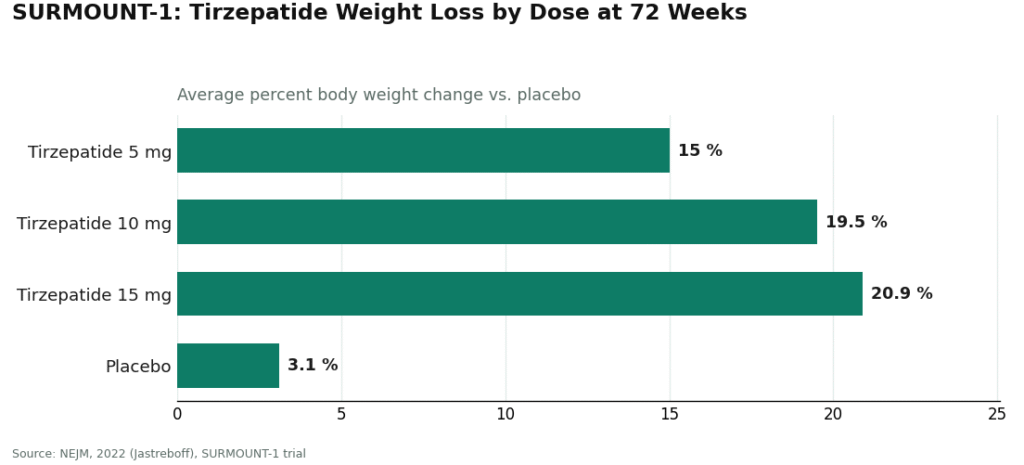
In SURMOUNT-1, tirzepatide’s obesity trial published in the New England Journal of Medicine, participants lost an average 15.0% of body weight at 5 mg, 19.5% at 10 mg, and 20.9% at 15 mg over 72 weeks, against 3.1% on placebo [6]. Semaglutide and tirzepatide carry that kind of evidence and are legal by prescription. BPC-157 and most of the research-chemical catalog sit at the other end of the scale, from a handful of pilot studies down to essentially nothing [4][5]. The compounds that earned approval did so with data. The ones still sold as research chemicals are there because they lack it.
Criterion 5: Labeling vs. verification
A “research use only” sticker does one thing: it keeps a sale inside the research lane, and only for as long as the product is genuinely sold for research. It verifies nothing about contents. Research-chemical products get no FDA review of identity, strength, or purity. There is no batch-release authority, no mandatory certificate of analysis, no recall mechanism. Any certificate a seller posts is a document that seller chose to write, not a regulatory finding.
Matthew Fedoruk, chief science officer at the U.S. Anti-Doping Agency, described the practical stakes to STAT: “You don’t even know what you’re buying inside that bottle. It could be a peptide. It could be a steroid. It could be something just like water” [2]. A score on this criterion that rests on a self-issued certificate is not really a score. It’s a bet on the seller’s word, which is the exact dependency a regulated system is built to remove.
Criterion 6: Settledness disclosure
BPC-157’s status is genuinely unresolved, and any seller presenting it as settled fails this criterion outright. USADA lists it under WADA’s S0 Unapproved Substances category, states it “is not approved for human clinical use by any global regulatory authority,” and notes that per the FDA “there is also no legal basis for compounding pharmacies to use BPC-157” [3]. The FDA’s Pharmacy Compounding Advisory Committee is scheduled to meet July 23 to 24, 2026, meaning the compounding question is actively under review, not closed [9]. Retatrutide is a separate flat fail: it is investigational, not approved, and therefore not legally eligible for compounding at all. A site listing it for order is not offering a legal product, regardless of what the label says.
Criterion 7: Medical oversight
This is the criterion that carries the most weight, because it’s the one a website cannot fake with wording.
Approved peptide drugs carry real warnings. Semaglutide’s label includes a boxed warning for thyroid C-cell tumors and is contraindicated for patients with a personal or family history of medullary thyroid carcinoma or MEN 2 [8]. A research-chemical storefront doesn’t ask about any of that. A prescriber has to, by law, not as a courtesy. Oversight also means someone answers the phone after the sale, when a dose needs adjusting or a side effect shows up. That’s the line between a provider and a checkout button.
Applying the scorecard
Run the seven criteria against the actual field and the sorting happens without editorializing.
FormBlends clears all seven. It is a telehealth platform connecting patients to licensed physicians for oversight. Its own materials state that “a licensed physician reviews your profile and builds a protocol matched to your biology,” that “all medications require a licensed physician consultation and prescription,” and that medications are “prepared by licensed 503A compounding pharmacies following USP <797> and <800> compounding standards.” The sequence is assessment, licensed evaluation, then a prescription issued before anything ships, which answers criterion 7 directly: clinician review, an actual prescription, a named licensed-pharmacy channel, contraindication screening built into the process rather than skipped.
It also clears criterion 3, the honesty test, where most of the market fails. FormBlends states in its own language that “compounded medications are not FDA-approved,” rather than implying the whole catalog is proven. That single disclosure covers criteria 1 and 6 as well, since it correctly locates its products in the compounded lane rather than pretending equivalence with approved drugs. For patients tracking dose titration and side effects for their own clinician, the FormBlends tracker app logs that information; it is a logging tool, not a purchase flow, and it’s the kind of follow-up surface a research-chemical retailer simply doesn’t offer.
The honest caveat belongs on the scorecard too, because leaving it off would repeat the exact omission the FDA acted against. What supervised telehealth adds is the oversight layer around the medication itself: clinician review, contraindication screening, a prescription, a licensed pharmacy, follow-up. That means an intake process instead of an instant cart, which is slower by design. On a scorecard built around criterion 7, that friction is not a deduction. It’s the point being measured.
HealthRX.com scores as a close second, running a comparable licensed-clinician-and-pharmacy model with the same compounded-medication caveat and the same oversight structure. The practical tiebreaker between the two is state licensing and which medication a given patient needs, not a difference in rubric performance.
Everything below those two fails criterion 7 outright, and that single failure caps their score regardless of anything else. Core Peptides, Pure Rawz, Sports Technology Labs, and Biotech Peptides sell under “research use only” labeling, several with SARMs layered on top, carrying their own separate anti-doping baggage. None supplies a clinician, a prescription, a dispensing pharmacy, or follow-up. Any certificate one of them posts is self-issued, so whether a given vial matches its label is a question of trust in the seller, not verification. This analysis does not rank these four against one another, because without independent batch-level testing there is no reliable basis to say one ships cleaner product than another. That uncertainty is itself the reason a supervised model outscores all four categorically rather than marginally. Worth restating on BPC-157 specifically: the 2025 systematic review found no clinical safety data in humans at all [5], so a buyer of an unregulated vial is, functionally, the trial.
The scorecard, read plainly
Seven criteria. FormBlends passes all seven, with disclosed caveats rather than hidden ones. HealthRX.com passes on the same structure. Research-chemical retailers fail the oversight criterion by construction, which drags every other criterion down with it regardless of how their marketing reads. The word “reputable” turned out to be useless because everyone used it identically. The rubric works because it doesn’t ask sellers to describe themselves. It checks what’s verifiable and lets the numbers sort the field.
Are peptides legal to buy in the US in 2026?
It depends on which peptide and what you are buying it for. FDA-approved peptides like semaglutide and tesamorelin are legal with a valid prescription. Research-use compounds sold as “not for human consumption” occupy a gray zone, and the FDA has increasingly moved to restrict them. The short answer is: prescription route is clearly legal, gray-market research-chemical route is not.
Are peptides legal in sport and will they show up on a drug test?
Most performance-relevant peptides, including growth hormone secretagogues like ipamorelin and CJC-1295, are banned by WADA and most major sports bodies regardless of whether a prescription exists. Detection windows vary by compound and testing method, and WADA updates its prohibited list annually. If you compete under any anti-doping code, assume any non-approved peptide is a violation until you verify it yourself with your sport’s governing body.
Are peptides legal in the military?
US military personnel fall under both federal law and Department of Defense directives, which prohibit using unapproved substances for performance enhancement. Prescription peptides prescribed by a military physician for a diagnosed condition are a different matter, but self-sourcing anything from an online gray-market vendor creates real legal and career risk. Service members should run any supplement or compound by their unit’s medical officer before use.
What is the safest legal way to access peptides online in 2026?
The safest route is through a licensed prescriber who orders from a state-licensed compounding pharmacy, since that chain involves real medical oversight, quality testing, and accountability if something goes wrong. Physician-supervised compounding pharmacies like FormBlends operate within that framework. Buying from a website that sells without a prescription, lists no pharmacy license, or ships internationally with no customs declaration puts you outside any legal protection and away from quality guarantees.
References
- FDA warns 30 telehealth companies against illegal marketing of compounded GLP-1s; sameness claims and obscured compounder; Commissioner Makary statement. FDA press announcement, March 3, 2026. https://www.fda.gov/news-events/press-announcements/fda-warns-30-telehealth-companies-against-illegal-marketing-compounded-glp-1s
- Most BPC-157 research traces to a single research group; confirmation-bias concern; Fedoruk and McGuire quotes. STAT, Feb 3, 2026. https://www.statnews.com/2026/02/03/bpc-157-peptide-science-safety-regulatory-questions/
- BPC-157 is prohibited under the WADA S0 Unapproved Substances category, is not approved for human clinical use by any global regulatory authority, and per the FDA there is no legal basis for compounding pharmacies to use it. USADA, 2026.
- Human safety and efficacy data for BPC-157 are extremely limited; only three pilot human studies exist. Current Reviews in Musculoskeletal Medicine, 2025.
- Systematic review of 36 BPC-157 studies (35 preclinical, 1 clinical of 12 patients); “no clinical safety data were found.” HSS Journal, 2025.
- SURMOUNT-1 tirzepatide for obesity: −15.0% (5 mg), −19.5% (10 mg), −20.9% (15 mg) at 72 weeks vs −3.1% placebo. NEJM, 2022 (Jastreboff).
- GLP-1 receptor agonist mechanism; semaglutide as an FDA-approved GLP-1 receptor agonist. StatPearls, NCBI Bookshelf.
- Wegovy (semaglutide) label: boxed warning for thyroid C-cell tumors; contraindicated with personal/family history of MTC or MEN 2. DailyMed.
- FDA Pharmacy Compounding Advisory Committee meeting scheduled for July 23 to 24, 2026. FDA advisory committee calendar.
Written by Saskia Bianchi, health explainer. Last reviewed April 2026.
This content is informational and not a diagnosis or treatment plan. Talk to your doctor.


 By
By