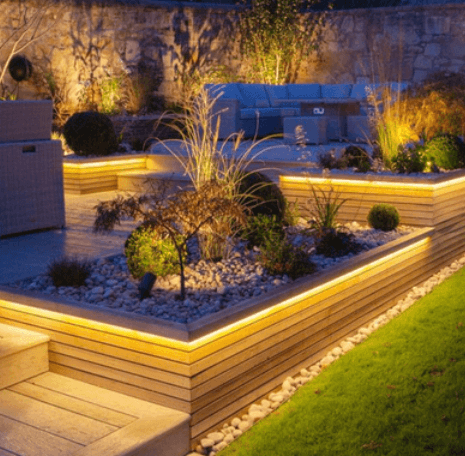

Outdoor LED strip lighting can change the appearance of a building, garden, pathway, sign, or architectural feature. However, outdoor installation requires more planning than simply selecting a bright strip. Moisture, temperature, installation length, voltage, power consumption, and protection ratings can all affect performance.
A suitable lighting system starts with matching the LED strip to the environment. The power supply also needs to match the strip’s voltage and total power requirement. When these factors are considered together, the installation becomes easier to manage and more consistent over time.
What Makes an LED Strip Suitable for Outdoor Use?
Outdoor areas can expose lighting to rain, humidity, dust, temperature changes, and accidental contact with water. This makes protection an important part of product selection. LED strips with IP65 or IP68 protection can be considered for different outdoor conditions, depending on the actual installation environment.
For example, waterproof 5050 LED strips are available with IP65 and IP68 ratings. These strips can be used for applications such as pathways, architectural features, signage, canopies, corridors, windows, and decorative installations.
The protection level should always match the location. A covered outdoor area may have different requirements from a strip installed where direct rain or water exposure is expected.
Choosing the Right LED Strip for the Installation
LED strips come in different LED types, voltages, power levels, colors, and physical sizes. A 3528 strip, for example, can use 300 LEDs over five meters and operate at either 12V DC or 24V DC, with a maximum power of 4.8W per meter.
A 5050 strip can provide a higher power output and is available in several colors, including red, green, blue, yellow, cool white, warm white, and RGB. Some versions can also be cut at defined intervals, making them easier to adapt to different installation lengths.
COB LED strips provide another option when continuous illumination is important. Their closely positioned LEDs create a more uniform appearance with fewer visible light spots. Free-cutting COB LED strips can also help when an installation has unusual dimensions or several short sections.
How to Match the Strip With Its Power Supply
Voltage compatibility should be checked before connecting an LED strip. A 12V strip needs a suitable 12V DC supply, while a 24V strip requires a compatible 24V DC supply. Using the wrong voltage can cause poor performance or damage to the lighting system.
You should also calculate total power consumption. For example, if a strip uses 12W per meter and you install five meters, the basic requirement is 60W. The power supply should have enough capacity to handle this load without continuously operating at its maximum rating.
Longer installations also require attention to voltage drop. A 24V system generally experiences less voltage drop than a comparable 12V system, which can make 24V strips more suitable for longer runs. If voltage drops significantly, the brightness can become weaker toward the end of the strip.
Outdoor Installation Considerations
Installation conditions can have a direct effect on LED strip performance. Before installation, check the surface, cable route, connection points, and expected exposure to moisture.
Adhesive backing can simplify installation on clean and suitable surfaces. Some 5050 strips use 3M adhesive tape for mounting. Aluminum profiles can also provide additional mechanical support and help with heat management.
Connections deserve particular attention in outdoor projects. Even when the LED strip itself has a suitable waterproof rating, exposed connectors and cable joints can become weak points. These areas should receive appropriate protection according to the installation conditions.
Selecting Outdoor LED Strip Lights for Larger Projects
For larger projects, buyers often need to consider product specifications in addition to price. LED quantity, power consumption, voltage, cutting length, PCB dimensions, waterproof rating, and color options can all affect the final selection.
When comparing Outdoor led strip lights wholesale options, it is useful to check whether the available products match the required voltage, protection level, brightness, and installation length. This approach helps avoid choosing a strip based only on appearance.
Shenzhen Dekingled Co., Ltd. was established in 2014 and operates from SanMing Industrial Park in Shenzhen, China. Its product range includes several LED strip formats, including 5050, 3528, 2835, 3014, COB, RGB, and silicone neon options.
Understanding Different LED Power Supply Options
The power supply is one of the most important components in an LED strip system. Different installations may require indoor IP20 supplies, rainproof models, slim designs, or waterproof power supplies.
When comparing LED Power Supply suppliers, look at voltage compatibility, rated power, protection level, dimensions, and the intended installation environment. The supply should have enough capacity for the connected LED load and should be suitable for the location where it will operate.
For outdoor applications, keeping the power supply and electrical connections properly protected can help reduce problems caused by moisture and environmental exposure. Technical specifications should be checked before installation rather than relying on assumptions about compatibility.
A Practical Checklist Before Installation
Before starting an outdoor LED strip project, check these points:
• Confirm whether the strip uses 12V DC, 24V DC, or another specified voltage.
• Calculate the total wattage required for the complete strip length.
• Select a power supply with suitable capacity.
• Check the IP rating for the installation environment.
• Consider voltage drop when planning long runs.
• Protect outdoor connectors and cable joints.
• Check the strip’s cutting length before making sections.
• Make sure the mounting surface is clean and suitable.
• Keep the power supply away from unnecessary exposure to water.
DekingLED lists fast delivery, cost-effective solutions, top quality, and technical support among its service advantages. The company can be contacted through Emily or Tony Wang at emily_led@dekingled.com and tonywang.deking@gmail.com.
See also: Nutrition on Tirzepatide: What to Actually Eat When You’re Barely Hungry
Final Thoughts
A reliable outdoor LED strip installation depends on more than choosing a bright light. The strip, voltage, power supply, protection rating, installation length, and surrounding conditions all need to work together.
Checking these specifications before installation can reduce compatibility problems and help create consistent lighting across the entire project. Whether the application involves architectural lighting, signage, pathways, gardens, exhibitions, or decorative features, careful planning makes the system easier to install and maintain.


 By
By


 By
By